
"A Large Language Model - or LLM - is the technology behind many of today’s AI tools that can write, summarise, answer, translate, analyse and hold conversations."
Claude, Gemini, Llama and GPT are all examples of Large Language Models. They are not apps in themselves, although they often power apps. Think of the LLM as the engine, and tools like ChatGPT or Claude as the vehicle you drive. You don’t interact directly with the engine but with the vehicle.
But what actually is it?
At its simplest, a Large Language Model is a trained system that produces language. It has been trained on huge amounts of text so that it can understand patterns in how language works. That includes grammar, facts, tone, structure, reasoning patterns, business terminology, coding examples, legal wording, marketing copy, customer service conversations and much more.
This does not mean the model “understands” things in exactly the same way a person does. It does not have human experience, opinions, common sense or judgement. What it can do is recognise patterns in the information it has seen and use those patterns to generate a useful response.
How does an LLM know what to write?
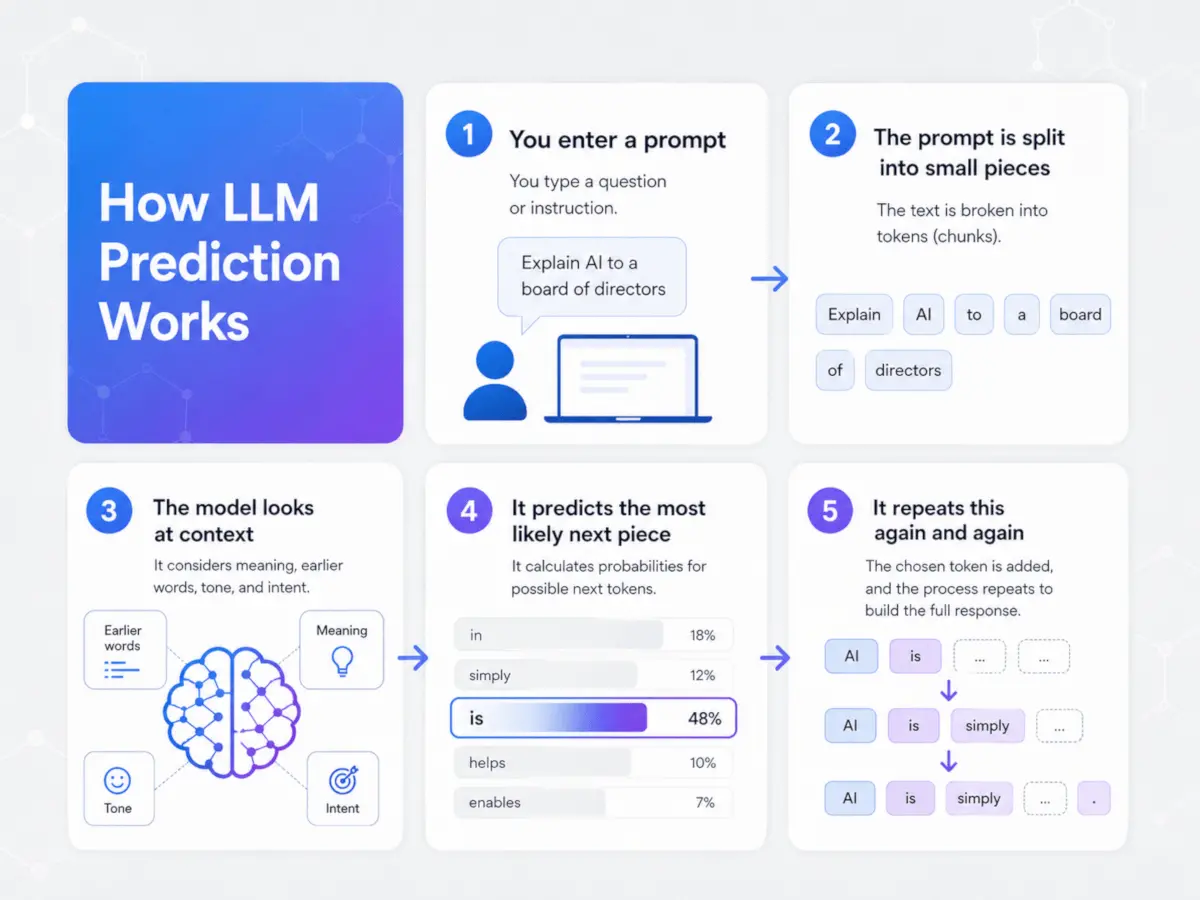
A useful way to understand a Large Language Model is to think of it as a highly advanced prediction system. When you type a question or instruction, the model breaks the text down into small pieces and looks at the surrounding context. It then predicts what should come next, one piece at a time, based on the patterns it learned during training.
That might sound simple, but the scale is what makes it powerful. It is not just guessing the next word in isolation; it is weighing up the meaning of the whole prompt, the likely intent behind it, the style of answer expected, and the relationships between ideas.
This is why an LLM can produce a paragraph that feels coherent rather than a random string of words. Each part of the response is influenced by everything that came before it.
For example, if you ask it to explain AI to a board of directors, it will choose different language, examples and structure than if you ask it to explain the same topic to software engineers. The model is still predicting what comes next, but it is doing so with a very rich understanding of context, tone and probability. In practical terms, this means it can generate new text that fits the task, rather than simply retrieving a pre-written answer from a database.
What are LLMs good at?
LLMs are particularly useful for work that involves language, information and communication. They can help draft emails, rewrite documents, summarise long reports, turn meeting notes into action points, suggest ideas, compare information, explain complex topics in simpler terms, and adapt content for different audiences.
For businesses, this makes them valuable across a wide range of everyday tasks. A sales team might use an LLM to create a first draft of a proposal. A marketing team might use one to generate campaign ideas or repurpose a webinar into a blog post. A customer service team might use one to draft clearer responses. A leadership team might use one to summarise research, reports or internal documents before making a decision.
Their real strength is not that they produce perfect finished work every time. It is that they reduce the friction involved in getting started. They can turn a blank page into a draft, a messy set of notes into a structure, or a long document into something easier to understand. Used well, they can save time, improve consistency and help people focus more of their attention on judgement, strategy and decision-making.
What are the limitations of a Large Language Model?
LLMs are powerful, but they are not infallible. Because they generate responses based on patterns, they can sometimes produce information that sounds confident but is wrong, incomplete or misleading. They may misunderstand vague instructions, miss important context, or make assumptions that a human expert would know to question.
This means they should not be treated as unquestionable authorities, especially in areas such as law, finance, medicine, compliance, technical advice or customer-facing decisions. In those situations, their output should be reviewed by someone with the right knowledge and responsibility.
The quality of the result also depends heavily on the quality of the instruction. A vague prompt will often produce a generic answer. A clear prompt that explains the audience, purpose, background, tone and desired format will usually produce something much more useful.
The best way to think about an LLM is as a capable assistant rather than a replacement for human judgement. It can speed up work, suggest options and help organise information, but people still need to check the facts, apply context, make decisions and take responsibility for the final output.